1

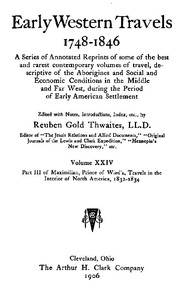
Maximilian, Prince of Wied's, Travels in the Interior of North America, 1832-1834, part 3 and appendix — Text and Context
7
1
Project Gutenberg
2015
Indians of North America; United States -- Description and travel; Indians of North America -- Languages; Natural history -- United States
Readers of public-domain and historical texts
Project Gutenberg digital edition
en
Edition facts
Words: 117,929
Reading time: 513 min
Text sections: 52
Source:
Project Gutenberg record #48235
This volume covers the final chapters of Maximilian, Prince of Wied's 1832-1834 North American journey, from winter at Fort Clarke through return via Ohio Canal and Niagara Falls. The appendix combines linguistic and natural history materials. The narrative shifts from detailed ethnographic observation to rapid travelogue, with the editor's annotations providing historical context.
Editorial Edition Score
4.9/5
★★★★★
★★★★★
Calculated from edition completeness, EPUB availability, text structure and catalogue metadata. Not a user rating.
Edition quality
The narrative in this third part of Maximilian's travels opens during a winter sojourn at Fort Clarke, where the pace of the text slows to match the season. The prince records daily life among the Mandan and Hidatsa with a naturalist's precision, noting details of dress, ritual, and subsistence. The voice is methodical, almost diaristic, as he describes the construction of earth lodges and the preparation of bison hides. This measured observation contrasts sharply with the later chapters, where the journey home accelerates into a catalogue of towns, canals, and steamboat routes. The shift in tempo—from ethnographic immersion to brisk travelogue—is one of the volume's most striking structural features.
Winter at Fort Clarke: Ethnographic Detail and Narrative Rhythm
The chapters covering November 1833 to April 1834 form the ethnographic core of this volume. Maximilian's prose adopts a patient, enumerative style: he itemizes the contents of a medicine bundle, describes the process of tanning hides, and notes the precise arrangement of a Mandan village. The sentences are often long, packed with specific observations—the weight of a buffalo robe, the angle of a lodge pole. This density of detail creates a sense of immersive time, where the reader experiences the slow rhythm of winter quarters. The prince's voice remains that of a curious outsider, but his willingness to record mundane routines—the repair of a canoe, the distribution of food—gives the text an anthropological texture that anticipates later ethnography.
The Return Journey: Accelerating Pace and Changing Register
From April 18, 1834, the narrative shifts dramatically. The return voyage from Fort Clarke to Leavenworth is compressed into a single chapter, and the prose becomes telegraphic. Maximilian lists distances, river conditions, and the names of passing settlements with little elaboration. The voice loses its ethnographic patience; observations become cursory. By the time he reaches the Ohio Canal and Lake Erie, the text reads like a logbook: “Clyde, in Wayne County, New York, had its first permanent settlers in 1811.” The editor's footnotes swell to fill the gaps, providing historical data on towns and salt springs. This change in register—from thick description to rapid itinerary—mirrors the traveler's own shift from explorer to tourist, and it raises questions about how the prince's attention was shaped by his audience and his own fatigue.
The Appendix: A Composite of Languages and Natural History
The appendix combines materials from both the London and German editions, offering vocabularies of Native American languages and lists of plants and animals. Here Maximilian's voice is taxonomic: he presents Mandan words for body parts, or notes the habitat of a particular bird. The structure is list-like, with minimal narrative framing. This section reveals the prince's dual identity as a naturalist and linguist, but it also underscores the editorial hand of Reuben Gold Thwaites, who merged two separate appendices into one. The result is a dense reference section that feels almost detached from the travel narrative preceding it. Readers interested in the scientific ambitions of early nineteenth-century exploration will find this part particularly valuable, though it demands a different mode of attention than the preceding chapters.
This volume rewards readers who attend to its shifts in pace and voice. The winter chapters demand patience; the return journey invites speed. The appendix stands apart as a reference work. Together, they document not only a geographical journey but also a transformation in the traveler's mode of seeing—from the immersive gaze of the ethnographer to the hurried glance of the passing tourist. The editor's annotations, while sometimes intrusive, provide a useful counterpoint to Maximilian's own observations.
Reader reflection
Record your reading impressions
A brief reflection can help important ideas stay with you longer.
Your progress
0
/
10
2
Did this book hold your interest?
3
How likely are you to recommend this book?
4
Did the language feel accessible?
5
Would you start a conversation about this book?
6
What did you think about the pace?
7
How distinctive were its ideas or approach?
8
Is this a title worth rereading?
9
What is the main idea you are taking away?
10