1

Rambles by Land and Water; or, Notes of Travel in Cuba and Mexico — A Closer Reading
4
1
Project Gutenberg
2011
Mexico -- Description and travel; Mexico -- Antiquities; Cuba -- Description and travel; Tamaulipas (Mexico : State); Veracruz-Llave (Mexico : State)
Readers of public-domain and historical texts
Project Gutenberg digital edition
en
Edition facts
Words: 57,399
Reading time: 250 min
Text sections: 7
Source:
Project Gutenberg record #36878
Benjamin Moore Norman's 1845 travelogue blends observations of Cuban and Mexican landscapes, customs, and antiquities with a detailed account of a canoe voyage up the Panuco River and explorations of Tamaulipas ruins, offering a firsthand view of mid-19th-century regional life.
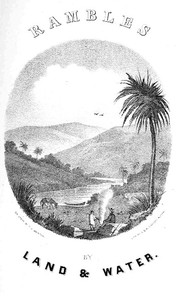
Benjamin Moore Norman opens his 1845 travel narrative with a preface that positions the work as a humble contribution to American ethnology, acknowledging that while some regions he traverses have been well documented, other portions—particularly his canoe voyage up the Panuco River and investigations of Tamaulipas ruins—are brought to light for the first time. He explicitly invites more capable explorers to undertake thorough investigations of these ruined cities, framing his own efforts as preliminary. The book's title page includes a motto: "He turns his craft to small advantage, Who knows not what to light it brings," signaling Norman's intent to illuminate obscure corners of Cuba and Mexico for an American readership.
A Self-Aware Traveler's Frame
Norman's preface reveals a writer conscious of his limitations and his audience. He describes his work as a "humble offering" and admits that others may have treated the same subjects "with as much fidelity to truth, and in a more attractive form." Yet he asserts that certain matters are "now, for the first time, brought to light." This self-deprecating yet purposeful tone recurs in the narrative: when describing his accommodations at a rancho, he notes that a letter of introduction ensured he was "treated more like a prince than a common traveller," but he undercuts the compliment with a wry account of sleepless nights plagued by insects and chickens. The reader should watch for this blend of earnest observation and dry humor, which often surfaces when Norman's comfort is compromised.
Material Culture and Social Observation
Norman pays close attention to clothing, housing, and daily objects as markers of social and economic conditions. In one excerpt, he describes the rebosa—a narrow scarf worn by Mexican women—as indispensable, noting that a woman might wear a costly twenty-five-dollar scarf while her body was "miserably covered" with a petticoat that few beggars would wear. This detail reveals Norman's eye for incongruity and his interest in how people prioritize adornment over basic covering. Similarly, his description of the rancho's "lady's room" inventories a bedstead without bedding, a dressing table with "sundry condemned combs, oil-bottles, scissors and patches," and a demijohn of aguardiente alongside saddles, guns, and swords. Such inventories ground the narrative in tangible specifics.
The Canoe Voyage as Structural Backbone
The subtitle promises a "canoe voyage up the River Panuco," and the excerpts show that this journey structures the middle portion of the book. Norman measures distances precisely—"twenty miles from the brick-yard" to the mouth of Topila Creek—and names local landmarks and landowners, such as Mr. Coss of Tampico. The voyage also occasions encounters with indigenous people, whom he describes in terms of color, stature, and perceived religious spirit. He judges the people he meets on the Panuco as "the most unfavorable specimen of the natives" he has seen, contrasting them with those of southern Mexico. These passages blend travelogue with ethnographic commentary, though Norman's assessments are subjective and should be read as period attitudes rather than objective fact.
Ruins and the Promise of Discovery
Norman's preface emphasizes the "mysterious relics of a mysterious race" and the "immense" field of American antiquities, which he says is "scarcely entered upon." The excerpts do not include his actual descriptions of ruins, but the preface establishes that his explorations of Tamaulipas ruins are a central goal. He frames his work as an incentive for others: "From what he has been enabled to accomplish, alone and unaided, he hopes that others, more capable... will be induced to make a thorough exploration." Readers approaching the full text should expect that the ruins sections will likely combine detailed architectural description with speculative remarks about the origins of the people who built them—a common feature of 19th-century travel writing on pre-Columbian sites.
Norman's narrative moves between self-deprecating humor, precise material description, and earnest antiquarian ambition. Readers will benefit from tracking how his tone shifts between the discomforts of travel and the allure of ruins. The excerpts suggest that the book's value lies less in systematic ethnography than in the juxtaposition of everyday details—a costly scarf on a poorly dressed woman, a sleepless night in a bamboo house—with the grand mystery of lost civilizations. Approach the text as a period document that reveals as much about the observer as about the observed.
Reader reflection
Your personal reading reflection
Build a private reading journal entry for this title.
Your progress
0
/
10
2
How did the book work for you overall?
3
Would you encourage someone else to read it?
4
How easy was the book to follow?
5
Would a second reading be valuable?
6
Would you start a conversation about this book?
7
How clear did the writing feel?
8
What was the strongest part of the book?
9
What did this book teach you most?
10