1

Scrambles Amongst the Alps in the Years 1860-69 — Inside the Classic
13
3
Project Gutenberg
2012
Alps -- Description and travel; Whymper, Edward, 1840-1911; Mountaineering -- Alps -- History -- 19th century; Mountaineers -- Biography
Readers of public-domain and historical texts
Project Gutenberg digital edition
en
Edition facts
Words: 100,323
Reading time: 437 min
Text sections: 26
Source:
Project Gutenberg record #41234
Edward Whymper's firsthand account of his Alpine climbs from 1860 to 1869, including his early attempts on the Matterhorn and the first ascent of the Pointe des Écrins, reveals a mountaineer who balances technical observation with vivid descriptions of the physical and emotional challenges of the mountains.
Whymper opens his narrative with a Latin epigraph from Livy—'Toil and pleasure, in their natures opposite, are yet linked together in a kind of necessary connection'—immediately establishing the dual character of his Alpine experiences. The table of contents reveals a decade of climbing, with the Matterhorn appearing in seven chapter titles before its eventual ascent in Chapter XXI. This structure signals that the book is not merely a chronicle of successes but a record of repeated attempts, setbacks, and the gradual accumulation of knowledge about the mountains.
The Matterhorn as a Recurring Presence
The Matterhorn dominates the book long before its final ascent. Whymper devotes multiple chapters to his attempts, each time detailing the route, the conditions, and the reasons for failure. In Chapter IV, 'My First Scramble on the Matterhorn,' he describes an early reconnaissance; by Chapter VII, 'Our Sixth Attempt to Ascend the Matterhorn,' the reader senses the growing obsession. The excerpts show Whymper's methodical approach: he notes the mountain's structure, the state of the snow, and the behavior of his companions. The Matterhorn is not just a peak but a puzzle to be solved through persistence and careful observation.
The Pointe des Écrins and the Weight of Experience
In Chapter IX, Whymper recounts the ascent of the Pointe des Écrins, but his tone is far from triumphant. He warns that anyone who reaches the summit 'after a fall of new snow' is likely to experience 'misery far deeper than anything with which he has hitherto been acquainted.' This passage reveals a key aspect of Whymper's voice: he is willing to share hard-won lessons, even when they caution against repeating his own feats. The description of the slope's danger—'its angle is severe, and the rocks do not project sufficiently'—shows his analytical eye for terrain and his commitment to honest reporting over romanticism.
Contrasts in Accommodation and Hospitality
Whymper's narrative is punctuated by sharp contrasts between the comfort of mountain huts and the squalor of valley inns. In Chapter X, he flees the 'foul den' of a cabaret at Val Louise for the 'clean straw' of a chalet at Entraigues, where the hospitality is 'most cordial.' These details ground the high-altitude drama in the mundane realities of travel: bad food, noisy lodgings, and the relief of finding a kind host. The midnight arrival of Monsieur Reynaud, who 'energetically pursued us during the night,' adds a touch of farce to the otherwise serious business of exploration.
The Role of Local Guides and Companions
Whymper frequently acknowledges the contributions of his guides and local companions. In the excerpts, he names Almer, Reynaud, and others, showing that his climbs were collaborative efforts. The guide Almer is sent ahead to scout routes; Reynaud, the 'excellent agent-voyer of La Bessée,' joins the party after a night march. These figures are not mere servants but active participants whose knowledge of the terrain is essential. Whymper's respect for their skills is evident, and his narrative often shifts between his own perspective and the collective experience of the party.
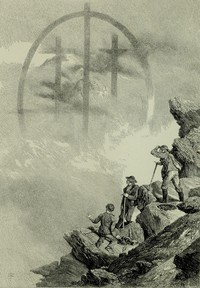
Readers approaching Scrambles Amongst the Alps for the first time should pay attention to Whymper's habit of embedding warnings and reflections within his adventure narratives. The book rewards those who read slowly, noting the technical details of routes and the subtle shifts in tone between triumph and caution. The appendices and illustrations—such as the 'Fog-bow seen from the Matterhorn'—add another layer, offering visual evidence of the phenomena he describes.
Reader reflection
Take a moment to reflect on this book
Create a short personal record of your experience with this book.
Your progress
0
/
10
2
Was reading this book enjoyable?
3
Would you recommend this book to another reader?
4
How easy was the book to follow?
5
How useful were the ideas in this book?
6
How well did it match your expectations?
7
Did any part of the book feel personally relevant?
8
Is this a title worth rereading?
9
What changed or sharpened your thinking?
10