1

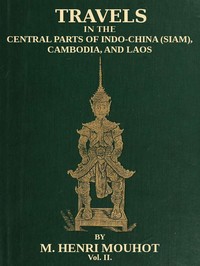
Travels in the Central Parts of Indo-China (Siam), Cambodia, and Laos (Vol. 2 of 2) During the Years 1858, 1859, and 1860 — A Closer Reading
7
1
Project Gutenberg
2014
Cambodia -- Description and travel; Thailand -- Description and travel; Natural history -- Indochina; Khmer language
Readers of public-domain and historical texts
Project Gutenberg digital edition
en
Edition facts
Words: 69,121
Reading time: 301 min
Text sections: 10
Source:
Project Gutenberg record #46560
Henri Mouhot's second volume details his 1858-1860 expeditions through Siam, Cambodia, and Laos, combining natural history observations with descriptions of ruins, local customs, and landscapes. The text includes scientific appendices on new species and a Cambodian vocabulary, reflecting his dual role as naturalist and explorer.
Editorial Edition Score
4.8/5
★★★★★
★★★★★
Calculated from edition completeness, EPUB availability, text structure and catalogue metadata. Not a user rating.
Edition quality
Henri Mouhot's second volume continues his journey through Southeast Asia with a naturalist's eye for detail and a traveler's curiosity about the people and places he encounters. The narrative shifts between precise descriptions of fish species—complete with fin-ray counts and scale patterns—and vivid accounts of Siamese ceremonies, such as the removal of a young man's topknot. Mouhot's observations are grounded in the specific: he notes the serrated margins of a præoperculum and the architecture of a triumphal arch at Ongcor Thôm with equal care.
The volume is structured as a travel journal, supplemented by appendices that include a Cambodian vocabulary, translations of Chinese tales, and a paper read at the Royal Geographical Society. This mix of scientific rigor and cultural documentation gives the work a dual character, blending field notes with personal narrative.
A Naturalist's Precision Amidst Ruins
Mouhot's training as a naturalist is evident throughout the text. In the appendix, he describes new species of fish with meticulous measurements: the height of the body is 'one-half of the total length (without caudal),' and the interorbital space is 'convex, nearly twice as wide as the orbit.' Such technical language sits alongside descriptions of the ruins of Ongcor Thôm, where he notes the 'surrounding wall' and 'triumphal arch.' The juxtaposition suggests that Mouhot viewed both living creatures and ancient structures as subjects for systematic observation.
His accounts of local customs, such as the ceremony for a young Siamese coming of age, are similarly detailed. The illustrations listed—'View of the Port and Docks of Bangkok,' 'Grotto at Pechaburi'—indicate a visual record that complements the written one. Yet the excerpts provide only fragments of these scenes, leaving the reader to infer how Mouhot integrated his scientific and cultural interests.
Encounters with Authority and Danger
Mouhot's journey brought him into contact with Siamese nobility, including a portrait of 'Khrom Luang, brother of the King of Siam.' The text also mentions 'Kun Motte, a Siamese Noble and Savant,' suggesting intellectual exchange. However, the travel was not without peril: one illustration depicts 'M. Mouhot and his Servants surprised by a Leopard,' and the narrative includes a bivouac in the forests. The editor, Charles Mouhot, notes that the journal ends with the traveller's death, lending a somber note to the volume.
The excerpts do not reveal the circumstances of Mouhot's death, but the inclusion of letters addressed to his family and a paper read at the Royal Geographical Society indicate that his work was valued by contemporaries. The volume thus serves as both a scientific record and a memorial to a life cut short.
Linguistic and Cultural Documentation
The appendix includes a 'Cambodian Vocabulary,' suggesting Mouhot's effort to engage with local languages. This linguistic work complements the translations of 'Chinese Tales and Fables' and the notes on 'The Damier, or Cape Pigeon' and 'The Albatross.' The range of topics—from folklore to ornithology—reflects Mouhot's broad curiosity.
Yet the excerpts offer only glimpses of these materials. The vocabulary is listed but not reproduced, and the tales are mentioned without content. What emerges is a portrait of a traveller who sought to document not only the natural world but also the cultural and linguistic landscapes he encountered. The volume's structure, with its mix of journal entries and appendices, mirrors the multifaceted nature of his expedition.
Readers approaching this volume should be prepared for a work that shifts between scientific cataloging and personal narrative. Mouhot's eye for detail rewards those who appreciate precise observation, while the incomplete nature of the excerpts invites speculation about the full scope of his journey. The appendices, particularly the vocabulary and species descriptions, offer a glimpse into the methods of a 19th-century naturalist-explorer. This is a document of a specific time and place, filtered through the lens of a single, determined traveller.
Reader reflection
Before you leave, reflect on the book
Use these questions to collect your thoughts before moving on.
Your progress
0
/
10
2
How did the book work for you overall?
3
Would you encourage someone else to read it?
4
What was the reading difficulty like?
5
Did the book give you something worth debating?
6
How clearly were the main ideas presented?
7
How strongly did the book affect you emotionally?
8
How strong was your personal connection to the text?
9
What did this book teach you most?
10